

Episode Description
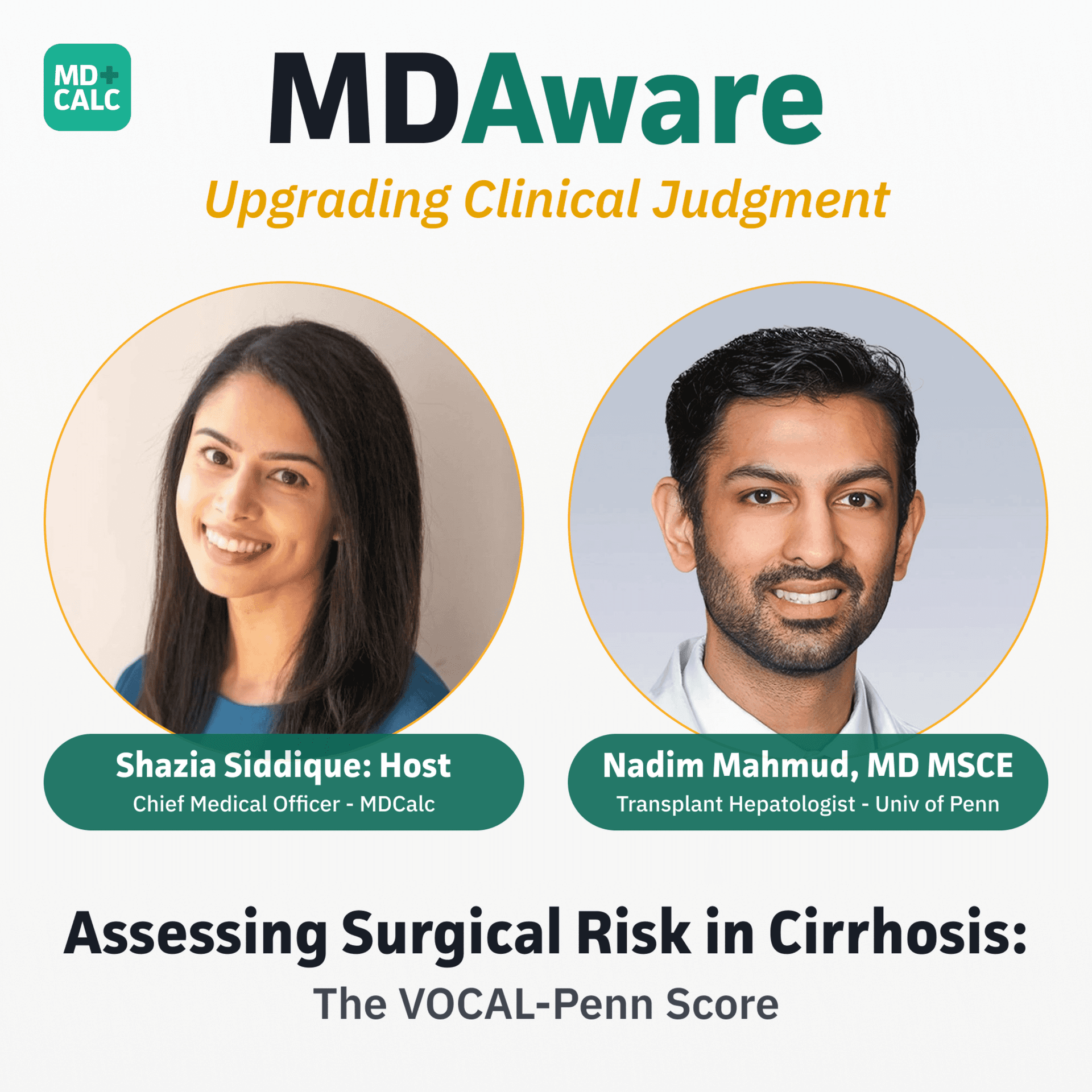
In this episode of MD Aware: Upgrading Clinical Judgment, host Dr. Shazia Siddique sits down with Dr. Nadiem Mahmud, Assistant Professor of Medicine in the Division of Gastroenterology and Hepatology at the University of Pennsylvania, to explore one of the most clinically impactful new tools now available on MDCalc: the VOCAL-Penn Score. Designed to predict postoperative mortality and cirrhosis decompensation in patients with liver disease, the VOCAL-Penn Score addresses a longstanding gap that has challenged hepatologists, gastroenterologists, and surgeons for decades.
Dr. Mahmud walks through how the score was born out of real clinical frustration with existing tools like the MELD score, Child-Pugh score, and Mayo Risk Score, all of which frequently produced wildly discordant estimates that clashed with clinical intuition. The VOCAL-Penn Score takes a more comprehensive approach, incorporating surgery type as a key variable and delivering four distinct outputs: 30-day, 90-day, and 180-day postoperative mortality risk, as well as 90-day risk of cirrhosis decompensation. Now used by more than 50,000 clinicians annually across the globe and endorsed by both the American College of Gastroenterology and the European Association for the Study of Liver Disease, the tool is reshaping how clinicians approach surgical risk conversations with their patients.
Dr. Siddique and Dr. Mahmud also dig into the common misapplications of the score, what a VOCAL-Penn 2.0 might look like, and why the move to MDCalc represents a major step forward in making this tool accessible to the four out of five US clinicians who already use the platform every day.
What You'll Learn
- How the VOCAL-Penn Score improves on older cirrhosis surgical risk tools by incorporating surgery type and delivering four distinct risk outputs to support shared decision-making
- Why there is no single hard cutoff for proceeding with surgery, and how a 15% projected 90-day mortality threshold can serve as a trigger for preoperative liver transplant evaluation
- Common pitfalls when applying the score, including using outdated lab values, applying it to unsupported surgery types, and failing to calculate risk for both laparoscopic and open surgical scenarios
- What a future version of the tool may include, such as broader surgery categories, additional cardiometabolic risk factors, and more diverse patient populations
Links & Resources
MDCalc: mdcalc.com
VOCAL-Penn Score on MDCalc: mdcalc.com
VOCAL-Penn Score original site: vocalpennscore.com
University of Pennsylvania Gastroenterology and Hepatology: pennmedicine.org
American College of Gastroenterology: gi.org
European Association for the Study of Liver Disease: easl.eu
Follow MDCalc on LinkedIn: linkedin.com/company/mdcalc
Follow MDCalc on X/Twitter: @MDCalc
Listen On

